Showing posts with label art. Show all posts

Monday, April 2, 2012

Eureka!


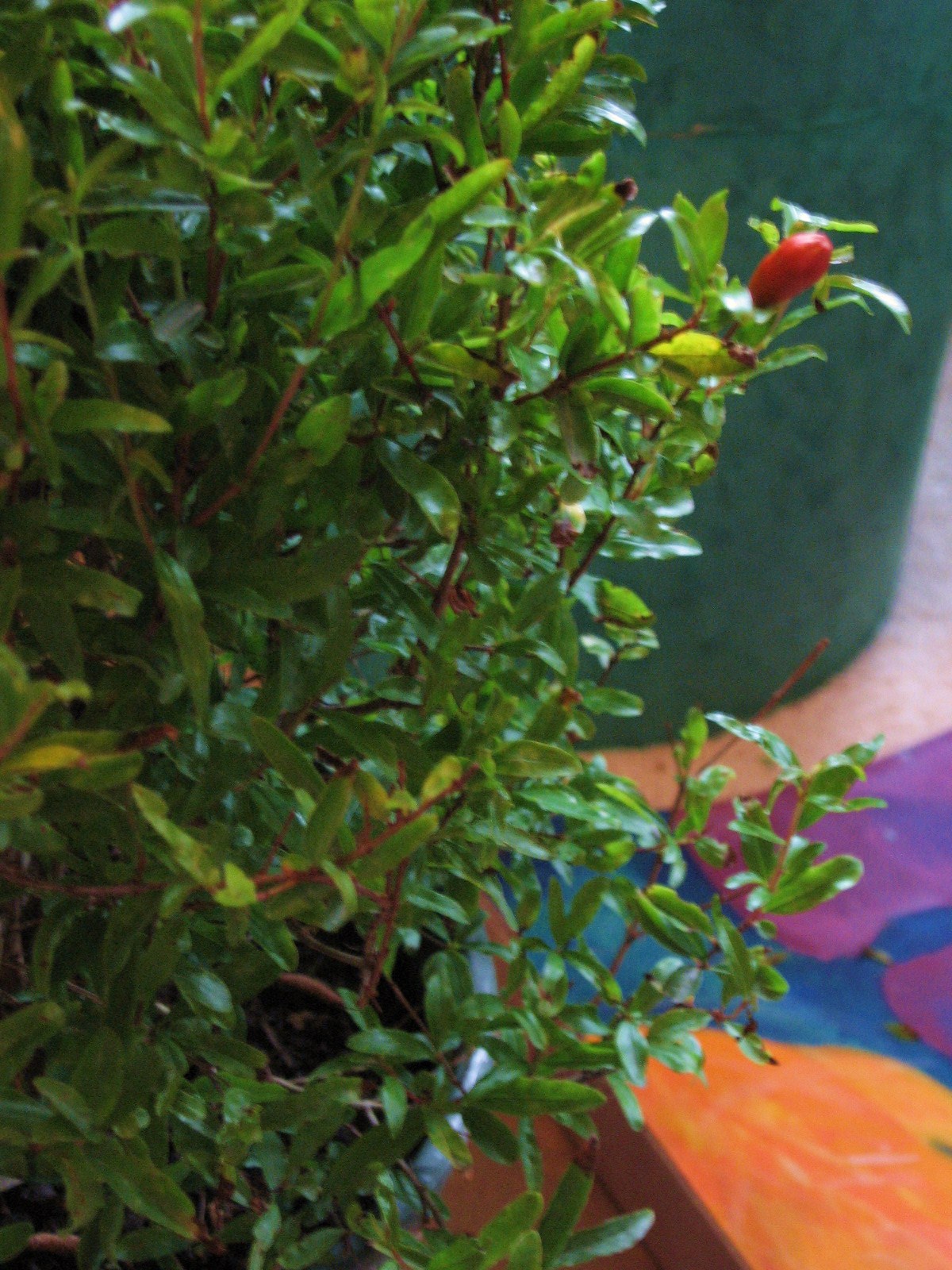
I finally found a place that has miniature pomegranate bushes! These have the intense orange flowers and even the fruit of the larger tree (I’m told that the fruit is essentially inedible, that it’s very sour)—except that all the parts are sized to fit my small balcony garden! Pomegranates often turn up in my art, so it’s natural that I would grow them.

Better yet is the “discovery” of the wonderful garden center that had the miniature pomegranate. To my sorrow, though it’s been there twenty-five years I have never before heard of it--but now I know. The large open areas surrounded by trees reminded me of my grandparents’ backyard. I was so blessed to find an interesting variety of healthy plants, helpful staff and a gift shop that looks like (at hurried glance since they were closing) it yields many treasures that I was almost overwhelmed—in a good way. The ground up grey surface underfoot even felt good to walk on. I’ll be back! http://kingsgreenhouse.com/retail

*Eureka means “I found it!”

Monday, February 20, 2012

Party Worthy


A fellow art student fascinated me with the story of the Night Blooming Cereus given to her by a friend who inherited it from her mother. The plant was so valuable her friend said that in case of fire, it would be grabbed to go. It had, I was told, a wonderful short-lived flower with a glorious fragrance.

While looking through some of my old photos for something “new” to paint, I was elated to find a picture of my California aunt’s Night Blooming Cereus.

When I exhibited the resulting painting another artist gifted me with a cutting from her special plant. When her Night Blooming Cereus blooms, she throws a party so her friends can enjoy the fragrance with her!

I’ve been growing the cutting in the same little pot for about twelve years; it hasn’t grown very much though it’s happiest in its current space. More sun and more water seem to suit it well. I’ve been hesitant to repot it since I had heard somewhere along the way that they need to be pot bound in order to bloom; I’m always hopeful. However, I think this year is its time to spread out—and maybe get it some fertilizer.

*Oil Painting Night Blooming Cereus

Thursday, December 1, 2011

100th Post!


I began this blog last July as a fun summer project to share my balcony garden with you. One hundred posts later (didn’t know I could!), it’s become much more. It has helped discipline me in my writing and I’ve taken hundred’s of photos of many aspects of my garden. I’ve been happily stretched.

One friend is amazed that I can have such diversity in such a small garden. Plants change as they grow—that’s part of what I like about gardening. Several—even non-gardeners, have said that they find refreshment and stress-relief as they read my posts each day. I’m pleased. That's why I share my garden.

As I’ve shared my successes and not-so-successful gardening experiments with you, people from many parts of the world have looked in. Gardening is, for the most part, universal. Like it or not, small gardens will likely become the norm as cities and populations throughout the world grow out—and up. One doesn’t have to own acreage to grow a beautiful garden.


I’ve been amazed at the variety of natural kingdom visitors making their way to my “tree house” garden, some enjoyable like this tiny frog, and others such as the leaf-chomping giant grasshoppers, dreaded.

While I’ve dedicated this blog to God, the original Artist and Gardener,Creator of everything, I wasn’t interested in making it into a “daily devotional”. If I saw a parable then good, I’d share it with you but didn’t contrive everything to fit a devotional template. I have however, ended up sharing some of the deep things the Lord is working in me, along with the joys of his creation.

http://leafyjournal.blogspot.com/2011/09/same-song-second-verse.html
http://leafyjournal.blogspot.com/2011/09/garden-watered-by-god.html
http://leafyjournal.blogspot.com/2011/10/to-bloom-again.html


I’ve also shared some nuts and bolts of gardening how-to’s from my years of gardening experience, working in flower/plant shops and reading garden books—my first book club purchases as a child.


Of course, as an artist, color is a really big deal for me and
always influences my garden as well as my posts.


I hope you’ll "visit" with me in my garden for many more “sunrises.” I’d love to get your feedback in comments or e-mails (leafyjournal@yahoo.com). There’s even a place at the end of each post to click on “reactions” to the post and a place to click for sharing the post on facebook, twitter or through e-mail—bring your friends, the more the merrier. Thanks for stopping by!
Wednesday, November 30, 2011

Meet Oskar


Oskar isn’t a puppy or a kitten but a red amaryllis bulb. Oskar is the variety name for this giant red and there are undoubtedly millions of them—but then there are millions of Davids and Anns too. One of my garden books says that the best bulbs are sold by name rather than color; the named ones are grown “vegetatively” while the ones sold by color are grown from seed and not as good a quality*. The Latin name for amaryllis, Hippeastrum, is variably defined as knight on a horse, knight star or horse star (because it’s so big).

It’s been awhile since I’ve grown an amaryllis but I decided that it would be nice to have one for Christmas, and to share its growth with you.

I bought Oskar at a giant home improvement store, checking through several boxes to find one that had sprouted a bud rather than only leaves—sometimes if leaves come first, that’s all you get.

Boxes and boxes were stacked shoulder high; red, red & white striped, pink, pink & white, white & pink as well as white vied for attention. I leaned toward getting the deep pink but somehow, in my mind, amaryllis and red always go together—especially at Christmas. Besides, it had a gold-colored pot and I’ve inherited from my great grandmother, a fondness for gold paint.

My first memory of anything to do with amaryllis flowers is the name of the little girl in the movie The Music Man. A pint-sized Ron Howard liked her but was too embarrassed to talk to her since his lisp made her name very difficult to say.


Much later, though as I said, I had grown several amaryllis plants and photographed them and had drawn and painted most any other kind of flower, for some reason I couldn’t draw or paint an amaryllis. But I persisted and accomplished this collage/painting The Lord Turns My Darkness to Light.

*Crockett’s Indoor Garden, James Underwood Crockett; p.12

Friday, November 25, 2011

Colorful Company


The stalwart white petunias are no longer alone and no longer colorless. They have cheerful orange and purple violas (or Johnny Jump Ups) to keep them company. In pigments (such as paint or dye) white is considered to be a non-color (though in light, it contains all the colors). To an artist who paints in vibrant colors, white by itself just isn't enough. However, white petunias seem to have the most wonderful fragrance of all their fellows, so they usually find a place in my colorful world.

The petunias, though amazingly hardy in the face of several frosts, were nonetheless battered by an unknown assailants—probably snails or slugs. With trimming and new color, the whole garden-in-a-pot looks a lot better. I hope the slimy eaters don’t like violas.

I had bundled up in jacket, hat and scarf to venture out for the transplant but soon realized (after greeting a neighbor who probably wondered) that it was far warmer than I thought. Huh. Oh well, no problem; I easily remedied the situation by unbundling.

Wednesday, November 9, 2011

Garden to Art


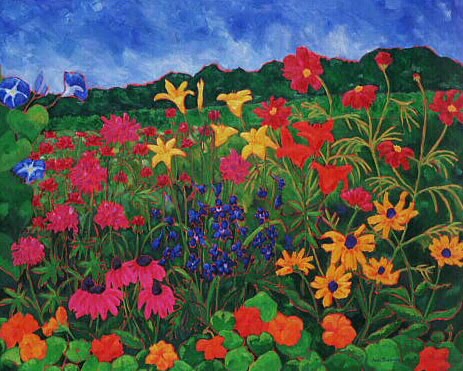
Gardens and my art have nearly always intertwined. I grew up around my grandmothers’ gardens and at home, in a creative atmosphere. When I realized (later than most) that it was time to go back to college I began working in flower shops to help finance my education. Since art school was my goal and I wanted to draw flowers, it made sense to get to know flowers even more personally.

During my college years (there were many) I had the opportunity to plant a garden amidst the mature landscape of the older house where we lived. I yanked English Ivy out of the neglected soil until I fell over backwards. More than once, I came face to face with angry bees that left me with a souvenir of the encounter. But I grew the garden pictured here.

Okay, so all these flowers didn’t bloom at once--though most could have, but that’s the beauty of art. Though my painting teacher frowned on such romance, when I graduated from her excellent training I consolidated my reference photos to paint The Artist’s Garden.

Hmm…a small garden spider just hopped onto my mouse pad—definitely harmless to me…

Wednesday, October 26, 2011

Just Getting Used to the World


My avocado plant is much happier indoors where it’s evenly warm though an avocado tree that has seen more than a hundred winters outside the Alamo—many with temperatures in the ‘teens, and ice, at last encounter, still branches broadly. But this young avocado is just getting used to the world.

Its temporary perch crowds and gives only moderate sunlight so I’ll be discovering a better spot soon. I’ll have to watch it closely to keep it from drying out (brown- spotted leaves are the price to pay) or I’ll have to transplant it to a plastic or glazed pot. I’d rather not disturb it unless it’s necessary, so I may be able to hold in some moisture by putting it in a jardinière (Wow, my spell-check recognized the word and automatically added the French accent. A jardinière is a decorative glazed pot in which to place a plainly-potted plant).

The painting in the photo is my mixed media painting, The Kingdom of Light based on Colossians 1:13,14.

Monday, October 10, 2011

To Grow Again

My “revived” avocado has sprouted two new sets of shiny bronzed leaves to replace the spindly top I pruned a month or so ago. Making the cut was a little scary but the plant will be bushier and more vigorous. It won’t reach as great a height but in a small garden that’s a plus.

Yesterday evening the full moon rose over a row of tables crammed with home-cooked foods as my husband and I and dozens of her other friends filled my friend B’s huge backyard. It was good to get out in the country in such beautiful weather. We tree-top dwellers are often limited to parks in order to spend much time with our feet in creation, so it’s especially nice when someone shares their yard. Thanks B!

I had some great art conversations, which sometimes turned to the subject of God’s speaking through his creation—the complexities, variety and sheer beauty of the things he has made. That’s why I’m so drawn to spending time outdoors and in my garden, why I’m refreshed there. God isn’t a part of creation but is revealed through it.

“For since the creation of the world God’s invisible qualities—his eternal power and divine nature—have been clearly seen, being understood from what has been made…” Romans 1:20

Thursday, October 6, 2011

When Life Breaks Things


When life gives you broken stems—make a flower arrangement! Two of the Angel Face Angelonia stems were hanging at an angle, broken by the weight of the sheet that kept them warm.

I snipped the flowerful branches and put them in a vase with a tall, narrow neck. I added the smallest branch of Persian Shield and the straightest Parrot Leaf I could find. When I take cuttings, I always try to leave at least one set of nodes (growth joints) behind so the remaining stem will branch out (grow again or “revive”).

I needed a third flower to complete the arrangement since design, whether floral or art calls for an uneven number. The deep pink Penta’s color seems to be made for the Parrot Leaf’s beautifully “painted” leaves (a member of the Joseph’s Coat family), so I gave the star clusters the starring role. I stripped the Penta’s leaves before adding it to the arrangement, or they would have hidden the more colorful ones.

Much of art these days is made of things not often thought of as art, broken things, cast aside things. But this isn’t just modern art; in past centuries--even millennia as they are today, many artists’ pigments are made from soil/dirt. Pigments such as burnt sienna and burnt umber are made from baked dirt. We artists use what’s around us--granted, we have to pay a lot for art materials companies to process them, but we make something beautiful out of the ordinary, even the broken. God, the ultimate Artist does the same with people giving us—when we turn to him through Jesus, the most wondrous beauty, a reflection of his glory.

Friday, September 30, 2011

Fall Foliage of a Different Sort


When I first bought my compact croton, the leaves were small, upright red spears. Now in their home in my garden they get full sun half of the day and the new leaves are larger and spreading. They’re also more green than anything else, which can be a sign of a lack of light. However, since they get lots of sun, it may be a sign of immaturity. ☺ Apparently, at least in the croton clan, "the older and wiser" you are, the more colorful!

I’ve long been fond of the multi-colored, spotted gems. This is a painting I made in art college. What a challenge to paint all the colors and spots; I often lost my place! But I persevered in “capturing” the beauty.

I saw the little lizard again the other day--with a beautiful long, intact tail.

Wednesday, August 31, 2011

Varying Levels


When Hurricane Irene headed for the East Coast of the U.S. last weekend, I had to take my hanging baskets and wind chimes down. It was really just a precaution since we only had a bit of bluster; the forecasters said that the winds would gust up to forty mph. However, we’ve had as much as eighty mph since we’ve lived in this home with no problem—that’s not to say that others didn’t have problems with their trees or that it wasn’t scary, but that my garden and home were fine.

Though very crowded around my feet, without the hanging elements, the garden looked barren above—like a big gaping hole. I realized again how important it is to me to have a garden that surrounds me on various levels. I’ve never been satisfied with a flowerbed with ankle or knee-high plants that I peer down at. In art classes, we artists are always told, that we need to vary the view in our paintings in order to keep the eye interested, “Never make any two things (or lines), even if they are like things, exactly the same.”

My husband and I bought the wind chimes at a Renaissance Festival in 1979; they’ve held up remarkably well all these years. Still, I decided to restring the pipes before rehanging them; they’re strung with monofilament. I’m glad that I learned to tie knots in Girl Scouts and that my troop leader wouldn’t put up with “granny knots”!

Monofilament is a wonderful product; I use it a lot to hang things. It’s inexpensive, strong and nearly invisible.